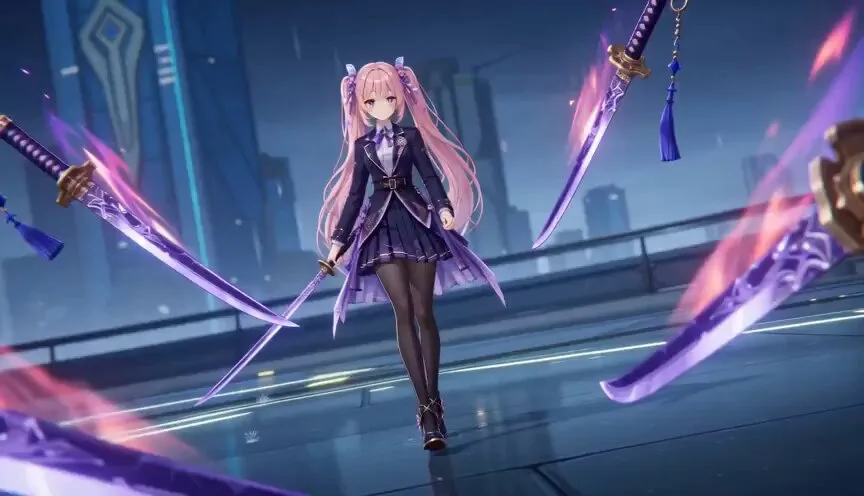
Floating swords duel in cinematic toon style
- Model
- Seedance 2.0
- Mode
- References to Video
- Duration
- 8 s
This prompt comes from a third-party source. We cannot guarantee that the example was made with exactly this prompt, so check it before you run it.
Prompt
高品質アニメ映像。高密度3Dトゥーン/セルルックによる映画的アクションRPGの高速剣戟。劇場版クラスのキーアニメーション、上質なコンポジット、透明感のある照明、密度の高い背景美術。8秒の短尺で、浮遊刀の猛攻、防御、回避、反力、包囲、最大衝突を高密度に連結する。
【参照画像と人物固定】
@1は一人目、キャラクターAの参照画像。
@2は二人目、キャラクターBの参照画像。
ソース参照画像のキャラクターを参照し、それぞれ同じ人物として維持する。参照画像はキャラクターの顔、目の形、虹彩色、髪型、髪色、衣装、装飾、体格、シルエット、雰囲気、キャラクターカラー、武器意匠だけに使用する。参照画像そのものの背景、部屋、家具、ポーズ、画角、フレーミング、文字、分割レイアウトは再現しない。
二人は全編でそれぞれsame person、same character identity。表情、視線、口元、姿勢、呼吸、自然な髪と衣装の揺れだけ変化してよい。特徴混合、顔の平均化、髪色交換、衣装交換、武器交換、体格変化、別人化、クローン化、分身、追加人物を発生させない。
【世界観と舞台の自動調整】
戦闘内容、位置関係、動作、力関係、刀数、カメラ構造は固定する。背景、小物、建築様式、床材、天候、照明、色味、粒子、環境エフェクトのみ、@1と@2のキャラクターデザインに合わせて再設計する。
二人の衣装、装飾、武器、素材、模様、固有色、モチーフから、両者が自然に存在できる一つの映画的戦闘舞台を新規構築する。学園都市、宮殿、神殿、庭園、幻想都市、工業施設、近未来空間などから最適な舞台を選ぶ。ただし参照画像の背景は直接コピーしない。
床には反射、水滴、砂塵、雪、花弁、火の粉、魔力粒子など、世界観に適した接触表現を配置する。欄干、柱、ガラス、樹木、機械構造、魔法装置、発光線などの小物は舞台に適したものだけを使う。背景は人物より一段暗くし、顔、シルエット、刀の軌道を明瞭にする。
キャラクターAの固有色を攻撃側のキーライト、浮遊刀のオーラ、斬撃残光へ使用する。キャラクターBの固有色を防御光、反撃残光、補助光へ使用する。両者の色は混ぜず、明確に識別できる状態を保つ。
【画風固定】
細く繊細な色付き輪郭線。顔、髪、衣装、武器に明快な二段から三段のセルシェーディングと透明感のある中間影。瞳は多層ハイライト、髪は繊細な束感、衣装は刺繍、レース、装甲、鎖、宝石、金具など、参照画像に存在するディテールを高密度に描く。
布、革、金属、宝石、ガラス、床を異なる反射率と粗さで描き分ける。太い黒輪郭、平坦な単層セル影、簡略TVアニメ、汎用3D美少女顔、プラスチックCG、低密度背景、半写実、実写、くすんだ色、画風混合にしない。参照画像の画風はコピーせず、高密度3Dトゥーン/セルルックへ統一する。
【武器固定】
キャラクターAは手持ち刀一本と、身体の周囲に浮かぶ四本の浮遊刀を使用する。浮遊刀はAの上、下、左、右を囲むように配置する。キャラクターBは手持ち刀一本を使用する。映像全体の刀は合計六本に固定する。
参照画像の武器が刀ではない場合も、その武器の色、素材、意匠、装飾、モチーフを継承した刀へ再設計する。
浮遊刀は刀身、鍔、柄が接続された完全な一本の刀。攻撃時のみ明確な飛翔軌道で動き、接触または回避後はAの周囲へ戻る。増殖、消失、融合、変形、余分な刀の追加を行わない。切っ先や刀身だけを独立回転させない。手持ち刀は柄だけを握り、刀身を手で掴まない。
【浮遊刀エフェクト】
四本の浮遊刀はキャラクターAの固有色を中心とした薄い炎状、霧状、粒子状、電光状のオーラを纏う。表現形式はAの世界観に合わせるが、必ず刀身へ密着させる。移動方向へ短い尾を引き、巨大な独立レーザーや別個の光線にしない。斬撃残光は刀の掃引面に密着した湾曲残光として発生する。
【力関係】
キャラクターAは冷静に主導権を握る格上。四本の浮遊刀を時間差で操りながら、自身も手持ち刀で前進する。キャラクターBは高い剣技で猛攻を弾き、避け、受け流し、反撃を試みるが、攻撃方向が連続して変化するため徐々に押される。Aだけが前進し、Bだけが後退する非対称な移動を維持する。
【カメラ】
固定横視点ではなく、浮遊刀越しの斜め低角度、Bの肩越し、接触点の近距離、接触点を軸にした約60度の回り込み、最終衝突へ迫る斜め低空カメラを使用する。浮遊刀のレンズ前通過、環境粒子、床から跳ねる飛沫、刀光を短い遮蔽ワイプに使う。カメラと背景が回り、人物を無意味に回転させない。
【8秒の動作構成】
Cut 1:
四本の浮遊刀がAの上下左右に静止した状態から開始。カメラは二本の浮遊刀の間を抜ける斜め低角度で、Aの顔、上半身、装飾、手持ち刀を見せる。Aは静かに前進し、視線だけでBを捉える。直後、右上の浮遊刀が加速し、Bの左肩口へ斜めに飛ぶ。
Cut 2:
Bの肩越し。Bは両手の刀で最初の浮遊刀を刀身中央同士の単一接触点で外側へ弾く。金属火花、両者の固有色の魔力火花、環境粒子、反力が発生する。弾かれた刀は弧を描いてAの周囲へ戻る。続いて左下の二本目が床すれすれを走り、Bは低く沈んで紙一重で回避。左上の三本目が斜め上から降下し、Bは刀を返して受け流す。
Cut 3:
環境粒子の遮蔽からAを斜め前方で映す。Aは止まらず踏み込み、手持ち刀で右下から左上へ斬り上げる。Bは後退しながら受け止める。二本の手持ち刀が一点で接触した瞬間、右下の浮遊刀がBの側面から侵入する。Bは肩を引いて避けるが、姿勢が横へ流れる。Aは接触を滑らせて解除し、さらに懐へ入る。
Cut 4:
接触点を中心にカメラが約60度回り込む。Bは反力を利用して返し斬りを放つが、Aの浮遊刀一本が側面から接触し、Bの刀を上へ逸らす。Aは手持ち刀を左上から右下へ振り下ろす。Bは急いで受け止めるが、足元が滑り後方へ押される。残る三本の浮遊刀がBの左右と上方へ散開し、退路を狭める包囲構図を作る。
Cut 5:
斜め低空カメラ。左手前に前進するA、右奥に押し込まれるB。Bは最後の反撃として踏み込む。Aも前進を止めず、左下から右上へ上昇斬りを放つ。二本の手持ち刀が中央の単一接触点で明瞭なX字を形成する。浮遊刀一本がBの刀身へ側面から追加圧力を加え、残る三本は周囲で次の斬撃姿勢を取る。
Aの攻撃色とBの防御色が別々に立ち上がり、中心の狭い白熱核の外側に巨大な二色のX字色面を形成する。放射状の衝撃波、環境粒子、蒸気、火花が広がる。Bの後ろ足が滑り、膝が沈み、両腕と肩の防御線が崩れ始める。Aは低い重心のまま前へ力を通す。X字の発光が最大まで拡大し、Bの防御崩壊が始まった瞬間に即カット。戦闘継続。
【重大NG】
固定横の格闘ゲーム視点、左右対称の全身構図、鏡写しの同時ダッシュ、長い助走、長い鍔迫り合い、無意味な連続回転は禁止。刀はAの手持ち一本+浮遊四本、Bの一本、合計六本を固定。浮遊刀の増殖、消失、融合、変形、身体への貫通、切っ先だけの独立回転は禁止。手で刀身を握らない。独立レーザー、第三の光線、二色融合、全画面白飛びなし。追加人物、文字、字幕、ロゴ、透かし、UI、音響生成なし。
Translated
High-quality anime video. A cinematic action RPG with fast sword combat rendered in dense 3D toon / cel-look, with theatrical-grade key animation, refined compositing, translucent lighting and dense background art. An 8-second short that links floating blade assaults, defense, evasion, recoil, encirclement and the maximum collision with high density. [Reference images and person lock] @1 is the first person, character A's reference image. @2 is the second person, character B's reference image. Keep each as the same person per their reference: the references are used only for face, eye shape, iris color, hairstyle, hair color, costume, decoration, build, silhouette, atmosphere, character color and weapon design. Do not reproduce reference backgrounds, rooms, furniture, poses, camera angles, framing, text or split layouts. The two are the same person throughout (same person, same character identity). Only expression, gaze, mouth, posture, breathing and natural hair and cloth movement may change. Feature mixing, face averaging, hair color swap, costume swap, weapon swap, build change, becoming a different person, cloning, doubles and extra people are forbidden. [World and stage auto-adjustment] Battle content, positions, movements, power balance, blade count and camera structure are fixed. Only background, props, architecture style, floor material, weather, lighting, color tone, particles and environmental effects are redesigned to match @1's and @2's character designs. Build one new cinematic battle stage that both can naturally exist in from their costumes, decoration, materials, patterns and own colors. Choose the best stage from a school city, palace, temple, garden, fantasy city, industrial site or near-future space; the reference background is not copied directly. The floor gets contact effects that fit the world: reflections, water droplets, sand, snow, petals, embers or magic particles. Props such as railings, pillars, glass, trees, mechanical structures, magic devices and light lines are used only if suited to the stage. The background is darker than the people so the faces, silhouettes and blade paths read clearly. Character A's own color is used for the attacker's key light, the floating blades' aura and slash afterimages. Character B's own color is used for defensive light, counter-afterimages and fill light. The two colors are not mixed and remain clearly distinguishable. [Art style lock] Thin, fine colored outlines. Clear two- to three-step cel shading on face, hair, costume and weapons with translucent mid-tones. Eyes with multi-layer highlights; hair with fine strand clusters; costume with dense detail present in the reference, such as embroidery, lace, armor, chain, jewels and metal fittings. Cloth, leather, metal, jewels, glass and floor are drawn with different reflectance and roughness. No thick black outlines, flat single-layer cel shading, simplified TV anime, generic 3D beauty face, plastic CG, low-density background, semi-realism, live action, dull colors or mixed art styles. The reference image's art style is not copied; unify into high-density 3D toon / cel-look. [Weapon lock] Character A has one handheld sword and four floating swords orbiting its body. The floating swords surround A above, below, left and right. Character B has one handheld sword. The total number of swords in the video is fixed at six. If a reference weapon is not a sword, redesign it as a sword inheriting its color, material, design, decoration and motifs. Floating swords are one complete sword each, with blade, guard and hilt connected. They move on clear flight paths only while attacking, and after contact or evasion return around A. No multiplication, disappearance, fusion, deformation or extra swords. Blades or tips are never rotated independently. Handheld swords grip only the hilt; the blade is never held by hand. [Floating sword effects] The four floating swords are wrapped in thin flame-like, mist-like, particle-like or lightning-like auras centered on character A's color. The effect form follows A's world, but always hugs the blade. In motion they leave a short tail in the direction of movement; they are not huge independent lasers or separate beams. Slash afterimages are curved afterimages attached to the sweep surface of the blade. [Power balance] Character A is the calm superior who controls the initiative: manipulates four floating swords in staggered timing while advancing with its own handheld sword. Character B parries, dodges, deflects and tries to counter with high swordsmanship, but as attack directions keep changing, gradually gets pushed back. Only A advances and only B retreats: an asymmetric movement. [Camera] Not a fixed side view: a diagonal low angle past the floating swords, over B's shoulder, a close range at the contact point, a roughly 60-degree orbit around the contact point, and a diagonal low-altitude camera closing on the final collision. Floating-sword passes in front of the lens, environmental particles, floor spray and blade light are used as short wipes. Camera and background rotate; characters are not spun meaninglessly. [8-second action structure] Cut 1: starts with four floating swords still around A's top, bottom, left and right. The camera passes between two floating swords at a diagonal low angle showing A's face, upper body, decoration and handheld sword. A advances quietly and captures B with only its gaze. Immediately the upper-right floating sword accelerates and flies diagonally at B's left shoulder. Cut 2: over B's shoulder. B deflects the first floating sword to the outside at one single contact point, center of blade to center of blade, with both swords. Metal sparks, magic sparks in both colors, environmental particles and recoil occur. The deflected sword arcs back around A. Then the lower-left second sword runs just above the floor; B sinks low and dodges by a hair's breadth. The upper-left third sword descends diagonally from above; B turns the blade and deflects. Cut 3: from behind environmental particles, A is shown diagonally in front. A does not stop and steps in, slashing diagonally up from lower right to upper left with the handheld sword. B holds while retreating. At the moment the two handheld swords meet at one point, the lower-right floating sword enters from B's side. B draws the shoulder back to avoid, but the posture drifts sideways. A slides the contact to release and moves further into the chest. Cut 4: the camera orbits about 60 degrees around the contact point. B uses recoil to deliver a counter-slash, but one of A's floating swords strikes from the side and deflects B's blade upward. A swings the handheld sword down from upper left to lower right. B hurriedly catches it but the footing slips and B is pushed back. The remaining three floating swords scatter to B's left, right and above, forming an encirclement that narrows the retreat. Cut 5: low diagonal camera. A advancing on the left foreground, B pushed deep into the right background. B steps in for a last counterattack. A also keeps advancing and releases an upward cut from lower left to upper right. The two handheld swords form a clear X at a single central contact point. One floating sword adds side pressure to B's blade; the remaining three take up next slash positions around them. A's attack color and B's defense color rise separately, forming around a narrow white-hot core a giant two-color X-shaped color field. Radial shockwaves, environmental particles, steam and sparks spread. B's back foot slips, knees sink, and the defensive line of arms and shoulders begins to collapse. A pushes force forward with a low center of gravity. The X-shaped light expands to maximum, and the cut comes immediately when B's defensive collapse begins; battle continues. [Critical NG] Fixed side fighting-game view, symmetric full-body composition, mirrored simultaneous dash, long run-up, long blade lock, meaningless continuous spinning are forbidden. Six swords total: A's handheld plus four floating, B's one. No multiplication, disappearance, fusion or deformation of floating swords, no penetrating the body, no independent spinning of tips only. No hand gripping the blade. No independent lasers, third beam, fusion of two colors, full-screen white-out. No additional people, text, subtitles, logos, watermarks, UI, or sound generation.